86. Your Older Cat: A Complete Guide to Nutrition, Natural Health Remedies, and Veterinary Care by Susan Easterly
Naysayers will go on about how convenient it is that I am typing the last 14 entries in this reading challenge over a week and a half after the end of the challenge period. Thankfully, though I don't really care what negative people think about me for the most part, all of my close friends and family know that I did indeed finish this reading challenge in almost the timeframe I had set to read everything -- or, if you want to be flexible with your interpretation of "one month" and discount days when I didn't have time to read at all, or when I only had time to read maybe 30 pages before something else came up that needed my immediate attention, then I actually DID accomplish and even EXCEED the stated goal of reading 100 full-length books (or their equivalent) in 1 month (31 total days of reading). In fact, due to a counting error on my part, I read 6 complete books on my last reading day and accidentally thus completed 104 books in 34 total days, or 30 days of reading.
Now, to this particular book.
I have 3 cats: Stinkie, Squeaky and Munchkin. All 3 qualify as "older cats," or "senior cats" as my vet refers to them when they have their checkups, but Stinkie in particular is almost 16 in human years and has been suffering from kitty kitty IBD -- Inflammatory Bowel Disease -- for about 3 years. He has slowly lost almost half of his body weight, and I am about to take him to a holistic specialist vet to see if there might be other treatments we can try involving diet, vitamins, enzymes and probiotics before it is too late. This is a sad time for Stinkie as he continues to waste away, but his spirits remain high and he occasionally has bursts of playfulness, like when he sneaked into the basement early this morning and I couldn't find him at feeding time. I picked up this book at The Strand earlier this year and finally got around to reading it for this challenge. It is a good overview of the changes to expect with an older cat, but because I have been taking all 3 of my cats to the vet for regular checkups since I moved to my neighborhood 8 years ago, there was no new info in this book for me.
87. Whittling and Woodcarving by E. J. Tangerman
This book represents a visit for me down memory lane.
When I was a kid growing up in Owings Mills, Maryland, they had just built a then state of the art shopping mall in my area called Owings Mills Mall. In recent years, after several murders and much gang violence as the neighborhood "turned over," stores moved out and I believe that the mall is currently slated for demolition or extensive remodeling in an effort to attract a less violent sort of clientele.
When I was a kid, though, before the mall's downward spiral, I used to go there all the time with my parents and friends. One of my favorite stores at the mall was the B. Dalton Bookstore, where my parents used to let me buy maybe a book a week or so, if you average out over time. As I mentioned at the very beginning of this blog, I started off as a VERY remedial reader, and my folks were so happy that I actually wanted to read that they allowed me somewhat free reign when it came to my purchases.
As a kid, I was very into the outdoors -- hiking, fishing, trees, fossil hunting, and whittling. Sitting for hours at a time with a pocket knife or X-acto set and creating little figures and other carvings from sticks and scrap wood. At a certain point in my life, maybe from age 11 to age 14 or so, this was one of my favorite books. I think that my original copy is still at my parents' house, where I grew up. When I recently saw this book at a neighborhood thriftstore, I had to get it. Rereading this book literally allowed me to visualize and relive in glorious detail an entire portion of my very happy childhood. Many thanks to this book for that!
88. Yoga for Men Only by Frank Rudolph Young
I have had varying degrees of success over the years with home workout routines -- whether they have been weightlifting, calisthenics, pushups and pullups, sports-style stretching, martial arts, or yoga. This book isn't REALLY yoga -- at least not in the classic Indian sense of what yoga really is. It should be called "Isometric Muscle Flexing and Stretching Exercises That You Can Do At Home To Firm Your Body and Stop Being A Fat Bastard." However, as that title probably would not have sold the book in 1969 when it was first published, we are stuck with the current misnomer of a title.
This is a GREAT book. Ok, sure, the text that goes along with the exercises is hokey and just plain ridiculous at times. Maybe this was inspiring stuff in 1969; now it is just plain laughable. However, the exercises themselves, complete with their at times outrageous names (witness Dynamic Diaphraghm Piston Powering -- either while seated or standing), are really quite excellent, and most importantly FEEL GREAT!
I have several times considered selling my copy of this book, near mint and a first edition commanding almost $50 on Amazon (seriously), but every time I have gotten ready to list it in my store, something has reminded me how powerful these exercises are, how great I feel when I do several "reps" of each exercise in sequence, and when I complete all 25 separate movements. I have taken this book with my on several vacations -- to Israel in 2012, to China twice in 2013 and 2014, and I believe to Mexico earlier this summer if I remember correctly -- and I have to say, these exercises, while having absolutely NOTHING to do with traditional yoga as we understand the term today, constitute an amazing workout when you don't have access to a gym, or even on a rainy or snowy day when, like me, you work from home and you really don't feel like going out.
Wednesday, October 1, 2014
Monday, September 29, 2014
September 24: 2 Books
84. Fluent Forever: How To Learn Any Language Fast and Never Forget It by Gabriel Wyner

I try to read every language learning book that comes out as soon as possible after its publication date. I was not aware of this one until I ran into it quite serendipitously at a small mom and pop bookshop in SoHo recently while waiting to meet my good friend Alan for dinner at a local Israeli food joint.
As a language teacher (beginning Cantonese Chinese to non-native speakers for 3 years now and beginning spoken Mandarin Chinese to non-native speakers as of this past week (this is my first semester teaching that dialect)), I am usually not particularly impressed by popular books on language learning techniques and resources. Case in point, my personal opinion about Rosetta Stone, which I view as an excellent resource for intermediate and advanced learners but just about the worst method ever for absolute beginners. However, I was VERY impressed with this book -- so impressed that I intend to reread it this fall and contact the author to hopefully interview him for my foreign language learning blog, which I also plan to develop into a fully-funtional internet learning portal in 2015.
Because of my need to keep these reviews short, due to the fact that my life recently exploded with unintended and unforeseen time-suckers and I "shouldn't" even be using this time right now to type this entry, I will summarize my impression of this book by saying this: if you are interested in learning how to mount a multi-pronged approach to learning your foreign language or languages of choice right now in 2014 / almost 2015, THIS would be one of the first books you should read, especially if you are a Youtube / Skye / social media-savvy so-and-so and would like to spend a good portion of your time using these resources, along with various apps and electronic flashcard resources in your studies. Feel free to comment on this entry and I will elaborate if there is any interest. For now, I need to move onto the next review.
85. The Catcher in the Rye by J.D. Salinger
Boy feels that the entire world is phony and that no one he knows except for his younger sister and at times his older brother (who has sold out, but is still loved) are "real" individuals, saying what they mean and living life as they intend to live it. Boy has a fist fight with an arrogant prep school classmate and is kicked out of his umpteenth high school. Boy has a couple of weeks before he is due home in New York City for semester break. Boy travels to NYC early, accidentally hires a prostitute who is younger than him, and gets into another fist fight with said hooker's pimp when boy refuses to pay an inflated price for a trick he didn't even take. Boy calls up several girls and guys that he knows from his past in the hopes that they might not be phony like everyone else. Boy sneaks into his house and runs into his kid sister, who sees right through his scam and wants to be a part of his adventure. Kid sister refuses to back down and threatens to run away with boy. Boy relents and waits for his parents' arrival, so he can have yet another confrontation about yet another failure in his young life.
I am blessed to have my dad's original copy of this book from the late 1950s / early 1960s (alas, not a first edition pb, though), and I have read this copy 4 times now, I believe. I decided to reread this book because I have always enjoyed the writing style as well as the narrator's attitude towards trying to find meaning in life and in social interactions. Living in New York City, albeit 50 years after the main character of this book, the story has continued to resonate with me through multiple readings throughout my teens, twenties, thirties, and now forties. My friend Alan had mentioned this book in the same moment when he suggested that Fitzgerald's The Great Gatsby did not measure up to Dickens. I am not sure that I agree or disagree with that statement. Good writing must first and foremost resonate with the time and world of the contemporary reader. Great writing should continue to resonate with the lives of future generations. I think that this book accomplishes that, in its comparative simplicity of style and content. It has my vote of confidence as a part of the 21st century canon of American literature.

I try to read every language learning book that comes out as soon as possible after its publication date. I was not aware of this one until I ran into it quite serendipitously at a small mom and pop bookshop in SoHo recently while waiting to meet my good friend Alan for dinner at a local Israeli food joint.
As a language teacher (beginning Cantonese Chinese to non-native speakers for 3 years now and beginning spoken Mandarin Chinese to non-native speakers as of this past week (this is my first semester teaching that dialect)), I am usually not particularly impressed by popular books on language learning techniques and resources. Case in point, my personal opinion about Rosetta Stone, which I view as an excellent resource for intermediate and advanced learners but just about the worst method ever for absolute beginners. However, I was VERY impressed with this book -- so impressed that I intend to reread it this fall and contact the author to hopefully interview him for my foreign language learning blog, which I also plan to develop into a fully-funtional internet learning portal in 2015.
Because of my need to keep these reviews short, due to the fact that my life recently exploded with unintended and unforeseen time-suckers and I "shouldn't" even be using this time right now to type this entry, I will summarize my impression of this book by saying this: if you are interested in learning how to mount a multi-pronged approach to learning your foreign language or languages of choice right now in 2014 / almost 2015, THIS would be one of the first books you should read, especially if you are a Youtube / Skye / social media-savvy so-and-so and would like to spend a good portion of your time using these resources, along with various apps and electronic flashcard resources in your studies. Feel free to comment on this entry and I will elaborate if there is any interest. For now, I need to move onto the next review.
85. The Catcher in the Rye by J.D. Salinger
Boy feels that the entire world is phony and that no one he knows except for his younger sister and at times his older brother (who has sold out, but is still loved) are "real" individuals, saying what they mean and living life as they intend to live it. Boy has a fist fight with an arrogant prep school classmate and is kicked out of his umpteenth high school. Boy has a couple of weeks before he is due home in New York City for semester break. Boy travels to NYC early, accidentally hires a prostitute who is younger than him, and gets into another fist fight with said hooker's pimp when boy refuses to pay an inflated price for a trick he didn't even take. Boy calls up several girls and guys that he knows from his past in the hopes that they might not be phony like everyone else. Boy sneaks into his house and runs into his kid sister, who sees right through his scam and wants to be a part of his adventure. Kid sister refuses to back down and threatens to run away with boy. Boy relents and waits for his parents' arrival, so he can have yet another confrontation about yet another failure in his young life.
I am blessed to have my dad's original copy of this book from the late 1950s / early 1960s (alas, not a first edition pb, though), and I have read this copy 4 times now, I believe. I decided to reread this book because I have always enjoyed the writing style as well as the narrator's attitude towards trying to find meaning in life and in social interactions. Living in New York City, albeit 50 years after the main character of this book, the story has continued to resonate with me through multiple readings throughout my teens, twenties, thirties, and now forties. My friend Alan had mentioned this book in the same moment when he suggested that Fitzgerald's The Great Gatsby did not measure up to Dickens. I am not sure that I agree or disagree with that statement. Good writing must first and foremost resonate with the time and world of the contemporary reader. Great writing should continue to resonate with the lives of future generations. I think that this book accomplishes that, in its comparative simplicity of style and content. It has my vote of confidence as a part of the 21st century canon of American literature.
Wednesday, September 24, 2014
83 Books in 27 Days as of September 23 -- EITHER 4 or 6 more days left to The Challenge, depending on how you look at it...
So if we take my blog at face value and tally a total as of today, I have read 83 books so far. If you are rereading this entry (for whatever inane reason), you will note that I was off in my count, in my favor. I had thought I had read 79 books as of today. I am actually up to 83. No idea how that happened, but COOL!
27 total days / 83 books.
This represents 25 actual days of reading, which means that I have either 4 days or 6 days to finish the remaining 17 books. Let's see what I can accomplish in the next 4 days.
Thanks for following this Challenge so far. Let's see what the rest of the journey brings...
27 total days / 83 books.
This represents 25 actual days of reading, which means that I have either 4 days or 6 days to finish the remaining 17 books. Let's see what I can accomplish in the next 4 days.
Thanks for following this Challenge so far. Let's see what the rest of the journey brings...
September 23: 2 Books
82. The Whole World Guide to Language Learning by Terry Marshall
This book is also on my list of Top 5 Favorite Language Learning Books. I hope to read at least one of the other books from that list before the end of the current Challenge.
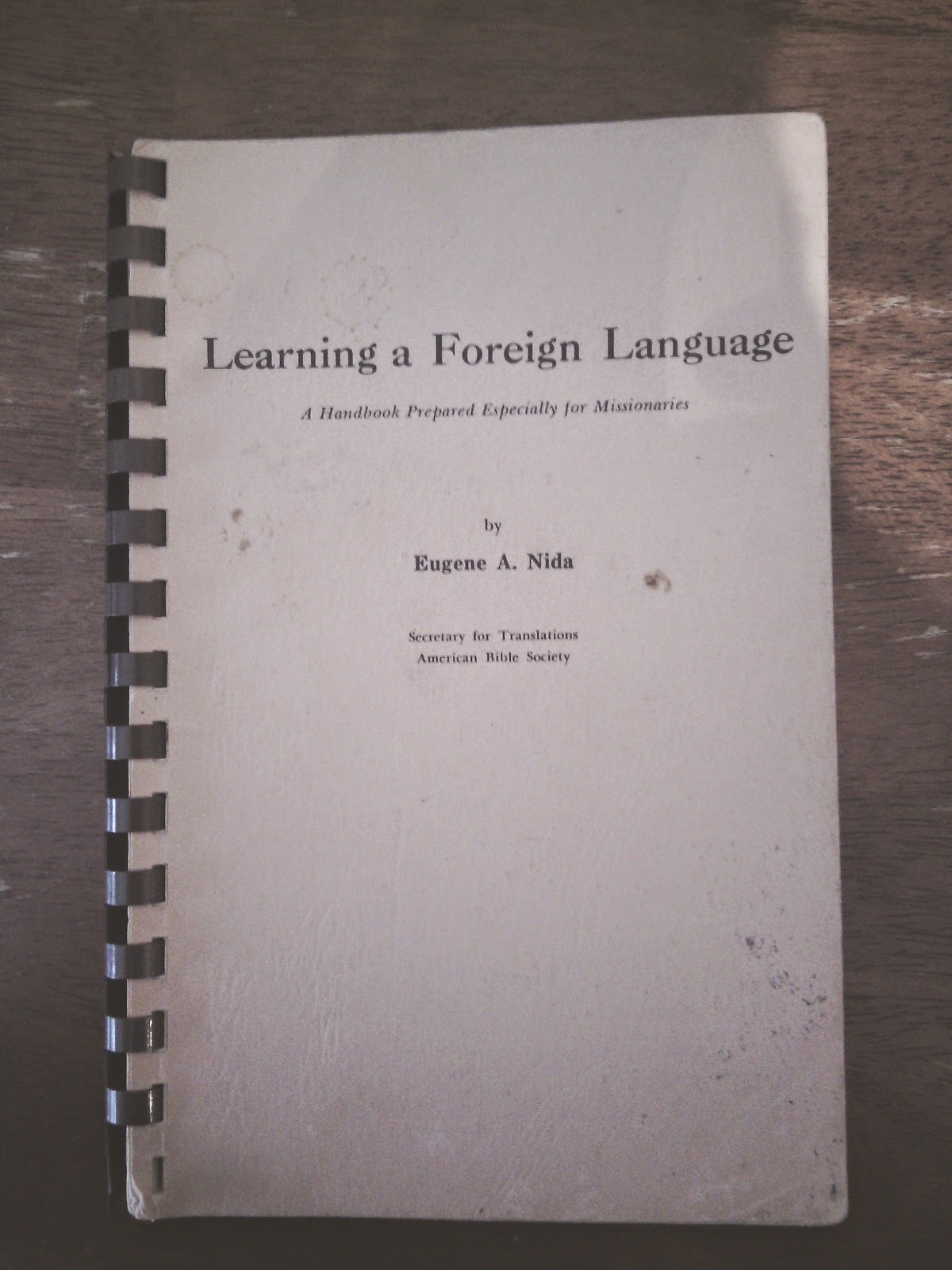
What I like most about this book is the same thing that I liked most about Nida's "missionary style" language learning field manual reviewed earlier in this blog: This book presents a wonderful method (though completely devoid of the pompous white man's burden ethos of earlier works in the genre, thank goodness!) for working with an "informer" or "mentor" in the field to learn the spoken version of a language from scratch without a textbook and without formal language classes or a dictionary. This method is not for the faint of heart and is most definitely only for dedicated, serious self-starters who really are determined to learn a new language on their own outside of the "traditional" classroom setting.
My copy of this book has so many dogeared pages at this point that I wouldn't know where to begin if I were to summarize the many excellent points in this short review. Perhaps I can simply say that I intend to suggest many of the methods from this book to my Cantonese and Mandarin students this fall, beginning next week, when I start volunteer-teaching beginning classes in each dialect in Manhattan's Chinatown.
83. In Other Words: The Science and Psychology of Second-Language Acquisition by Ellen Bialystok and Kenji Hakuta
Ostensibly an academic work on the subject, this book nevertheless maintains enough of a popular approach that it would certainly appeal to the average intermediate-level language learner looking for a broader understanding of the various research in recent years on language learning, and how that research might (or might not) help the language learner to acquire more of a given foreign language.
As with many of the books in my personal collection on linguistics and language learning, there needs to be some sort of distinction between books that aid in general language learning approaches and books that specifically further a knowledge about developments and prevailing theories within the field of linguistics as an academic social science discipline. This book falls into the second category.
This book does an excellent job of presenting multiple prevailing linguistic approaches or philosophies, and because this is a reread for me, my copy has many dogears and much underlining, ensuring that I will return to this book again at a later state when I want to delve deeper into an understanding of one or more concepts of the discipline of linguistics. In the short term, though, it doesn't lend much to an improvement in strategies that might increase my command of any of the languages that I am currently studying and attempting to speak.
This book is also on my list of Top 5 Favorite Language Learning Books. I hope to read at least one of the other books from that list before the end of the current Challenge.
What I like most about this book is the same thing that I liked most about Nida's "missionary style" language learning field manual reviewed earlier in this blog: This book presents a wonderful method (though completely devoid of the pompous white man's burden ethos of earlier works in the genre, thank goodness!) for working with an "informer" or "mentor" in the field to learn the spoken version of a language from scratch without a textbook and without formal language classes or a dictionary. This method is not for the faint of heart and is most definitely only for dedicated, serious self-starters who really are determined to learn a new language on their own outside of the "traditional" classroom setting.
My copy of this book has so many dogeared pages at this point that I wouldn't know where to begin if I were to summarize the many excellent points in this short review. Perhaps I can simply say that I intend to suggest many of the methods from this book to my Cantonese and Mandarin students this fall, beginning next week, when I start volunteer-teaching beginning classes in each dialect in Manhattan's Chinatown.
83. In Other Words: The Science and Psychology of Second-Language Acquisition by Ellen Bialystok and Kenji Hakuta
Ostensibly an academic work on the subject, this book nevertheless maintains enough of a popular approach that it would certainly appeal to the average intermediate-level language learner looking for a broader understanding of the various research in recent years on language learning, and how that research might (or might not) help the language learner to acquire more of a given foreign language.
As with many of the books in my personal collection on linguistics and language learning, there needs to be some sort of distinction between books that aid in general language learning approaches and books that specifically further a knowledge about developments and prevailing theories within the field of linguistics as an academic social science discipline. This book falls into the second category.
This book does an excellent job of presenting multiple prevailing linguistic approaches or philosophies, and because this is a reread for me, my copy has many dogears and much underlining, ensuring that I will return to this book again at a later state when I want to delve deeper into an understanding of one or more concepts of the discipline of linguistics. In the short term, though, it doesn't lend much to an improvement in strategies that might increase my command of any of the languages that I am currently studying and attempting to speak.
September 22: ZERO BOOKS (no real time to read today)
Today was a weird day, alternately of productivity and procrastination as I again worked on my own purge of items from my bedroom and home office in an effort to clarify and refocus my life. Before I knew it, the entire day had gone by.
Today was the second day this month that I was not able to read a book for this Challenge.
September 21: 6 Books
76. How to Improve Your Foreign Language Immediately: Foreign Language Communication Tools by Boris Shekhtman
Ok -- so this is a super short book -- around 100 pages, and even that is stretching it, considering the font size and typset of the text. Still, in light of the 543 page book that I read the other day, my friend Amanda at Roots Cafe in South Park Slope, Brooklyn assures me that I should count this as a full book. It was indeed published as a "full book" with its own isbn and its own separate listing on Amazon.com, where I purchased it in 2013.
I love love love love LOVE this book. It is not a book for beginning language learners. Rather, it is a distillation of the author's main points from his much longer work, Developing Professional Level Language Proficiency, which I also read earlier this year. In How To Improve Your Foreign Language Immediately, Shekhtman provides multiple CONVERSATIONAL STRATEGIES to take whatever level the language learner has attained and maximize what he or she is able to show during conversational interactions with native speakers of that language.
The ISLAND STRATEGY is my absolute favorite point of this book, and is the main reason that I will continue to reread this short, crucial work on language learning as well as recommend it to every single intermediate learner of any foreign language that I meet for the rest of my life!!!
77. How To Learn a Foreign Language by Edwin T. Cornelius, Jr.
This book originally came with a dust jacket, which my copy is missing. Rather than post a copy of the plain blue front cover of the non-jacketed hardback, I am instead including a cover of the interior title page for those who are interested in ordering this book on Amazon or perhaps taking it out of your local public library.
Published in the 1950s, this book contains a solid method based on finding a native speaker "informer" or "mentor" in your target foreign language and then preparing lessons for yourself that you then have your mentor teach you, based on your specific needs. In this respect, though the book focuses entirely on the author's experiences learning to speak modern Greek, the book follows much the same "missionary linguistic" approach to language acquisition as several of the upcoming entries in this blog.
I have decided to keep this short work as a permanent part of my language learning book collection for two reasons:
From what I can tell from my cursory research on Amazon prior to ordering this book in 2012, this was THE book for the 1950s / 60s generation of "Travel to a Foreign Country and Learn the Local Language to Convert the Heathens to The Word of God" brand of Christian Missionary. If the reader is able to put aside the white man's conceit that that is even remotely an appropriate way to approach other non-Western cultures, there is much of value in this thin, pithy volume.
I have dogeared many pages in my copy, and my intention a few days ago was to write a bit about some of the more salient points in this book. However, in the interest of time, let me just end this review by saying that if you are interested in going to a foreign country or immersing yourself in a foreign language speaking community in the US, and you are a self-starter who is genuinely interested in becoming fluently conversational in another language via a method focusing on conversations with locals in which you use the language (once you learn it at a basic enough level) to learn about the culture from which the language springs, THIS is a great book to check out. If, on the other hand, you are the sort of learner who insists on sitting in a class and having some teacher or "person of authority" tell you what to do, what to learn, then this is definitely NOT the kind of book for your language learning approach.
79. The Principles of Language Study by H. E. Palmer
This is a reprint of a book on language learning from the 1920s, and if ever there was a book written from the pompous "I am a white man and I know much more than you uncivilized heathens" perspective on other languages and cultures, this would be a shining example. Still, there are some positive points and because my personal interest in language learning and teaching is much more than cursory, it is very worthwhile for me to read books like this every once in a while -- if only to make me angry about the previous generations' notions of white man's privilege...
Focusing mainly on French language examples, the author does a good job of contrasting the fors and againsts regarding spoken vs. written language study at the outset of the student's efforts to acquire a new language. Most of the book focuses on the author's 9-point action plan for learning a new language:
80. Polyglot: How I Learn Languages by Kato Lomb
This is one of my Top 5 All Time Language Learning Books.
Written by one of the most accomplished interpreters of the latter half of the 20th Century, a Hungarian woman with a command of 16 languages who, most impressively AND MOST INSPIRING FOR ME, learned most of her spoken and written languages in her 30s and 40s, this book is both informative and specific in its prescription for language learning.
I have been a big believer in EXTENSIVE READING in a foreign language (my own Bombardment Theory of Language Learning, which I have promised to write more about either in this blog or at www.speakmanylanguages.com) for several years now -- before I was ever aware of Stephen Krashen's work on the topic or this book currently being reviewed here and now. It is always nice to be validated through one's reading on a given topic of passion that one's own thoughts and ideas happen to resonate with some of the current thinking in the field. Yay -- go me!
Ms. Lomb's detailed description of how she initially learned to speak Russian via reading a novel over and over again over a period of months during the wartime occupation of her country is both inspired and inspiring. Recently, I have applied the exact same method to my own reading and rereading of Dav Pilkey's seminal work, Capitán Calzoncillos y El Terrorífico Retorno de Cacapipí (the Spanish language edition of Captain Underpants and the Terrifying Return of Tippy Tinkletrousers), from which I have literally much improved my own conversational Spanish (albeit to a 10 year-old level).
81. A Linguistic Guide to Language Learning by William G. Moulton
This is a very dry work, focused mainly on Chomsky-style language tree diagrams and a circa 1970 understanding of the state of linguistics as a social science and how that science might aid foreign language learning. In actuality, I would argue that the contents of this book certain aid linguistics as a field, and would aid a student who wants to read ABOUT and think ABOUT language, but this particular book would do very little to actually help a student acquire a new language or learn to speak it.
This seems to be a common misunderstanding throughout the linguistics literature up until recent years: one does NOT need to study ABOUT how a language works in order to learn how to speak and use that language. Even in order to learn the grammar of that particular language. The only people aided by a book such as this would be linguistics who want to understand more about how language AS A CONCEPT might function at a deeper "social science research" level. Taken with that particular grain of salt, a book like this might be interesting to a linguist doing research into why certain language teaching methods might be more or less effective for certain segments of the population. However, this book does little to help a student learn to speak, read or write any specific language.
Ok -- so this is a super short book -- around 100 pages, and even that is stretching it, considering the font size and typset of the text. Still, in light of the 543 page book that I read the other day, my friend Amanda at Roots Cafe in South Park Slope, Brooklyn assures me that I should count this as a full book. It was indeed published as a "full book" with its own isbn and its own separate listing on Amazon.com, where I purchased it in 2013.
I love love love love LOVE this book. It is not a book for beginning language learners. Rather, it is a distillation of the author's main points from his much longer work, Developing Professional Level Language Proficiency, which I also read earlier this year. In How To Improve Your Foreign Language Immediately, Shekhtman provides multiple CONVERSATIONAL STRATEGIES to take whatever level the language learner has attained and maximize what he or she is able to show during conversational interactions with native speakers of that language.
The ISLAND STRATEGY is my absolute favorite point of this book, and is the main reason that I will continue to reread this short, crucial work on language learning as well as recommend it to every single intermediate learner of any foreign language that I meet for the rest of my life!!!
77. How To Learn a Foreign Language by Edwin T. Cornelius, Jr.
This book originally came with a dust jacket, which my copy is missing. Rather than post a copy of the plain blue front cover of the non-jacketed hardback, I am instead including a cover of the interior title page for those who are interested in ordering this book on Amazon or perhaps taking it out of your local public library.
Published in the 1950s, this book contains a solid method based on finding a native speaker "informer" or "mentor" in your target foreign language and then preparing lessons for yourself that you then have your mentor teach you, based on your specific needs. In this respect, though the book focuses entirely on the author's experiences learning to speak modern Greek, the book follows much the same "missionary linguistic" approach to language acquisition as several of the upcoming entries in this blog.
I have decided to keep this short work as a permanent part of my language learning book collection for two reasons:
- I intend to study classical Greek at some point in the future and when I do, it will be good to have an example of a practical Craigslist-style language trade method for learning modern conversational Greek at the same time; and
- There are some very sound "missionary" style language learning techniques in this book that I want to revisit in the future as I continue to re-evaluate my own language learning efforts in Chinese -- especially going forward as I begin to take my Chinese out "into the field" for personal fieldtrips to Cantonese and Mandarin speaking NYC Chinatowns and develop my own in-situ language "assignments."
From what I can tell from my cursory research on Amazon prior to ordering this book in 2012, this was THE book for the 1950s / 60s generation of "Travel to a Foreign Country and Learn the Local Language to Convert the Heathens to The Word of God" brand of Christian Missionary. If the reader is able to put aside the white man's conceit that that is even remotely an appropriate way to approach other non-Western cultures, there is much of value in this thin, pithy volume.
I have dogeared many pages in my copy, and my intention a few days ago was to write a bit about some of the more salient points in this book. However, in the interest of time, let me just end this review by saying that if you are interested in going to a foreign country or immersing yourself in a foreign language speaking community in the US, and you are a self-starter who is genuinely interested in becoming fluently conversational in another language via a method focusing on conversations with locals in which you use the language (once you learn it at a basic enough level) to learn about the culture from which the language springs, THIS is a great book to check out. If, on the other hand, you are the sort of learner who insists on sitting in a class and having some teacher or "person of authority" tell you what to do, what to learn, then this is definitely NOT the kind of book for your language learning approach.
79. The Principles of Language Study by H. E. Palmer
This is a reprint of a book on language learning from the 1920s, and if ever there was a book written from the pompous "I am a white man and I know much more than you uncivilized heathens" perspective on other languages and cultures, this would be a shining example. Still, there are some positive points and because my personal interest in language learning and teaching is much more than cursory, it is very worthwhile for me to read books like this every once in a while -- if only to make me angry about the previous generations' notions of white man's privilege...
Focusing mainly on French language examples, the author does a good job of contrasting the fors and againsts regarding spoken vs. written language study at the outset of the student's efforts to acquire a new language. Most of the book focuses on the author's 9-point action plan for learning a new language:
- Initial preparation
- Building proper habits
- Accuracy, particularly of pronunciation
- Gradation
- Proportion
- Concreteness of examples and language rules as the student acquires them
- THE STUDENT'S INTEREST LEVEL
- Order of progression of study materials and language aspects
- MULTIPLE LINE OF APPROACH
80. Polyglot: How I Learn Languages by Kato Lomb
This is one of my Top 5 All Time Language Learning Books.
Written by one of the most accomplished interpreters of the latter half of the 20th Century, a Hungarian woman with a command of 16 languages who, most impressively AND MOST INSPIRING FOR ME, learned most of her spoken and written languages in her 30s and 40s, this book is both informative and specific in its prescription for language learning.
I have been a big believer in EXTENSIVE READING in a foreign language (my own Bombardment Theory of Language Learning, which I have promised to write more about either in this blog or at www.speakmanylanguages.com) for several years now -- before I was ever aware of Stephen Krashen's work on the topic or this book currently being reviewed here and now. It is always nice to be validated through one's reading on a given topic of passion that one's own thoughts and ideas happen to resonate with some of the current thinking in the field. Yay -- go me!
Ms. Lomb's detailed description of how she initially learned to speak Russian via reading a novel over and over again over a period of months during the wartime occupation of her country is both inspired and inspiring. Recently, I have applied the exact same method to my own reading and rereading of Dav Pilkey's seminal work, Capitán Calzoncillos y El Terrorífico Retorno de Cacapipí (the Spanish language edition of Captain Underpants and the Terrifying Return of Tippy Tinkletrousers), from which I have literally much improved my own conversational Spanish (albeit to a 10 year-old level).
81. A Linguistic Guide to Language Learning by William G. Moulton
This is a very dry work, focused mainly on Chomsky-style language tree diagrams and a circa 1970 understanding of the state of linguistics as a social science and how that science might aid foreign language learning. In actuality, I would argue that the contents of this book certain aid linguistics as a field, and would aid a student who wants to read ABOUT and think ABOUT language, but this particular book would do very little to actually help a student acquire a new language or learn to speak it.
This seems to be a common misunderstanding throughout the linguistics literature up until recent years: one does NOT need to study ABOUT how a language works in order to learn how to speak and use that language. Even in order to learn the grammar of that particular language. The only people aided by a book such as this would be linguistics who want to understand more about how language AS A CONCEPT might function at a deeper "social science research" level. Taken with that particular grain of salt, a book like this might be interesting to a linguist doing research into why certain language teaching methods might be more or less effective for certain segments of the population. However, this book does little to help a student learn to speak, read or write any specific language.
September 20: 5 Books
71. What is History? by Edward Hallett Carr
I was all set to begin today with Kon-Tiki (see below), but when I was walking to my regular Saturday morning therapy session with my new social worker Joanne, I found this book on the street. What an amazing collection of lectures by the author on the philosophical implications of the concept of "history" and "historians," as these terms are understood from a European/American perspective! I had already read the first 2/3 of it by the time I walked the 30 blocks from my home to my appointment!
I was actually blown away by this book; it is not often that a book that I find in recycling rocks me to my core by laying bare the workings of Western education and exposing a fundamental truth that knowledge is as much a product of those who "create" it and tell us that it is important as it is of the things or events that are supposedly important in the first place.
Wow -- this is REALLY deep stuff. On the surface, this book is an exploration of the notion that history as we know it, as it is studied in school and written about by scholars, actually represents an almost equal participation from both the events and historical figures themselves AND the historians and writers commenting and creating insights on those people and events. Something about my mood this morning when I read this book, though, made me draw a much deeper connection regarding all "knowledge" in this world -- or at least the kind that I have learned so far in my limited time on this planet.
72. Kon-Tiki by Thor Heyerdahl
As readers will remember from my earlier entry on the book Columbus Was Last, I have long been fascinated with explorations into who were the first people to "discover" the Americas. Four of Thor Hyerdahl's books have been on my shelf for several years now, and I am finally getting around to reading them in chronological order of publication date.
Kon-Tiki is a very famous book, published in 1950, detailing the author's testing of his hypothesis (now a proven theory) that the various Polynesian islands (Samoa, Hawaii, Tahiti, etc.) were originally populated by early residents of the west coast of South America (now Peru), sailing west across many miles of ocean on balsa wood rafts. What an adventure story!
Reading like a novel, this true story is well-researched and detailed enough for even the most scientifically-minded to sit up and take notice of Hyerdahl's postulates regarding the initial peopling of Polynesia. I am really looking forward to reading his follow-up book, Aku Aku, on the building of the famous Easter Island statues.
73. The Nuer: A Description of the Modes of Livelihood and Political Institutions of a Nilotic People by E. E. Evans Pritchard
Everyone should read a famous social anthropologyical monograph written during the height of British Imperialism. The Nuer are an indigenous people of Sudan in Africa, and Pritchard was sent by the British government to chronicle their inner workings, presumable so that the British government might better and more efficiently subjugate these people to British Imperial rule.
The arrogance of the white man can be astounding at times.
Taken in stride as a reflection of the age from whence it came, this is a well-written book by one of the "fathers" of modern social and cultural anthropology, my undergraduate major at Duke University, from which I graduated a million and a half years ago.
Especially in light of today's earlier book, What is History?, I couldn't help but think the entire time that I read this book, how much of the author's experience and research represents "the truth" of The Nuer (i.e. the way these people really see and understand themselves and the significances of their own social, political, religious, etc. institutions as would be discussed between educated native speakers of their language), and how much are simply guesses on the part of Pritchard -- or worse yet, misinterpretations based on language mistranslation issues or possibly even purposeful misdirection on the part of the Nuer, who may not have wanted a white outsider to really know about their lifestyle and its meanings?
Hmm...
74. The Secret Power Within: Zen Solutions to Real Problems by Chuck Norris
Sometimes, I buy a book just for shits and giggles, and this particular book is an example of just such an impulse purchase.
However, I was very pleasantly surprised to find that Mr. Norris filled this book with some wonderfully insightful personal and career stories and some very valuable life insights.
Carried throughout the book is an underlying tribute to the author's brother, who died as a soldier in Vietnam, and it is this source of motivation that informed much of the author's personal philosophical quest to find deeper meaning and ultimately happiness in martial arts, movies, life and love. I found this book VERY inspiring -- so much so that I will be keeping it and rereading certain dogeared pages going forward as I reconceive my own life and career over the coming months. Funny enough, I think that maybe Chuck Norris's insights into the deeper meaning of the human condition are just what I need at this moment in my own life.
In all seriousness.
This is a witty and well-written, inspiring self-help book
75. Clear Your Clutter with Feng Shui by Karen Kingston
Ladies and Gentlemen, there is a new winner for "Most Inspiring Get Rid of Your Junk / Clean Your Home and Life Book..." and it's name is Clear Your Clutter with Feng Shui!
As my readers will see from all of the orange price tags in my cover photos of today's books, this afternoon provided a very profitable browsing session at The Strand Bookstore. I dogeared SOOO many pages in this book that I don't even know where to begin. THIS will actually be my bible for cleaning up my home and my life, starting next week, during my October focus on eliminating clutter from my apartment and my mind so that I can clarify and refocus my life and career going forward. Sometimes, we are very lucky to find a method to guide us through our moments of madness; this book represents just such a solution for me...
Focusing on the underlying symbology of most, if not all, clutter, this book REALLY resonated with my own personal battle to get rid of extra crap from my life. So much so this will most likely be the first book that I [re]read as soon as my 100 Book Challenge is finished!
I was all set to begin today with Kon-Tiki (see below), but when I was walking to my regular Saturday morning therapy session with my new social worker Joanne, I found this book on the street. What an amazing collection of lectures by the author on the philosophical implications of the concept of "history" and "historians," as these terms are understood from a European/American perspective! I had already read the first 2/3 of it by the time I walked the 30 blocks from my home to my appointment!
I was actually blown away by this book; it is not often that a book that I find in recycling rocks me to my core by laying bare the workings of Western education and exposing a fundamental truth that knowledge is as much a product of those who "create" it and tell us that it is important as it is of the things or events that are supposedly important in the first place.
Wow -- this is REALLY deep stuff. On the surface, this book is an exploration of the notion that history as we know it, as it is studied in school and written about by scholars, actually represents an almost equal participation from both the events and historical figures themselves AND the historians and writers commenting and creating insights on those people and events. Something about my mood this morning when I read this book, though, made me draw a much deeper connection regarding all "knowledge" in this world -- or at least the kind that I have learned so far in my limited time on this planet.
72. Kon-Tiki by Thor Heyerdahl
As readers will remember from my earlier entry on the book Columbus Was Last, I have long been fascinated with explorations into who were the first people to "discover" the Americas. Four of Thor Hyerdahl's books have been on my shelf for several years now, and I am finally getting around to reading them in chronological order of publication date.
Kon-Tiki is a very famous book, published in 1950, detailing the author's testing of his hypothesis (now a proven theory) that the various Polynesian islands (Samoa, Hawaii, Tahiti, etc.) were originally populated by early residents of the west coast of South America (now Peru), sailing west across many miles of ocean on balsa wood rafts. What an adventure story!
Reading like a novel, this true story is well-researched and detailed enough for even the most scientifically-minded to sit up and take notice of Hyerdahl's postulates regarding the initial peopling of Polynesia. I am really looking forward to reading his follow-up book, Aku Aku, on the building of the famous Easter Island statues.
73. The Nuer: A Description of the Modes of Livelihood and Political Institutions of a Nilotic People by E. E. Evans Pritchard
Everyone should read a famous social anthropologyical monograph written during the height of British Imperialism. The Nuer are an indigenous people of Sudan in Africa, and Pritchard was sent by the British government to chronicle their inner workings, presumable so that the British government might better and more efficiently subjugate these people to British Imperial rule.
The arrogance of the white man can be astounding at times.
Taken in stride as a reflection of the age from whence it came, this is a well-written book by one of the "fathers" of modern social and cultural anthropology, my undergraduate major at Duke University, from which I graduated a million and a half years ago.
Especially in light of today's earlier book, What is History?, I couldn't help but think the entire time that I read this book, how much of the author's experience and research represents "the truth" of The Nuer (i.e. the way these people really see and understand themselves and the significances of their own social, political, religious, etc. institutions as would be discussed between educated native speakers of their language), and how much are simply guesses on the part of Pritchard -- or worse yet, misinterpretations based on language mistranslation issues or possibly even purposeful misdirection on the part of the Nuer, who may not have wanted a white outsider to really know about their lifestyle and its meanings?
Hmm...
74. The Secret Power Within: Zen Solutions to Real Problems by Chuck Norris
Sometimes, I buy a book just for shits and giggles, and this particular book is an example of just such an impulse purchase.
However, I was very pleasantly surprised to find that Mr. Norris filled this book with some wonderfully insightful personal and career stories and some very valuable life insights.
Carried throughout the book is an underlying tribute to the author's brother, who died as a soldier in Vietnam, and it is this source of motivation that informed much of the author's personal philosophical quest to find deeper meaning and ultimately happiness in martial arts, movies, life and love. I found this book VERY inspiring -- so much so that I will be keeping it and rereading certain dogeared pages going forward as I reconceive my own life and career over the coming months. Funny enough, I think that maybe Chuck Norris's insights into the deeper meaning of the human condition are just what I need at this moment in my own life.
In all seriousness.
This is a witty and well-written, inspiring self-help book
75. Clear Your Clutter with Feng Shui by Karen Kingston
Ladies and Gentlemen, there is a new winner for "Most Inspiring Get Rid of Your Junk / Clean Your Home and Life Book..." and it's name is Clear Your Clutter with Feng Shui!
As my readers will see from all of the orange price tags in my cover photos of today's books, this afternoon provided a very profitable browsing session at The Strand Bookstore. I dogeared SOOO many pages in this book that I don't even know where to begin. THIS will actually be my bible for cleaning up my home and my life, starting next week, during my October focus on eliminating clutter from my apartment and my mind so that I can clarify and refocus my life and career going forward. Sometimes, we are very lucky to find a method to guide us through our moments of madness; this book represents just such a solution for me...
Focusing on the underlying symbology of most, if not all, clutter, this book REALLY resonated with my own personal battle to get rid of extra crap from my life. So much so this will most likely be the first book that I [re]read as soon as my 100 Book Challenge is finished!
Subscribe to:
Posts (Atom)